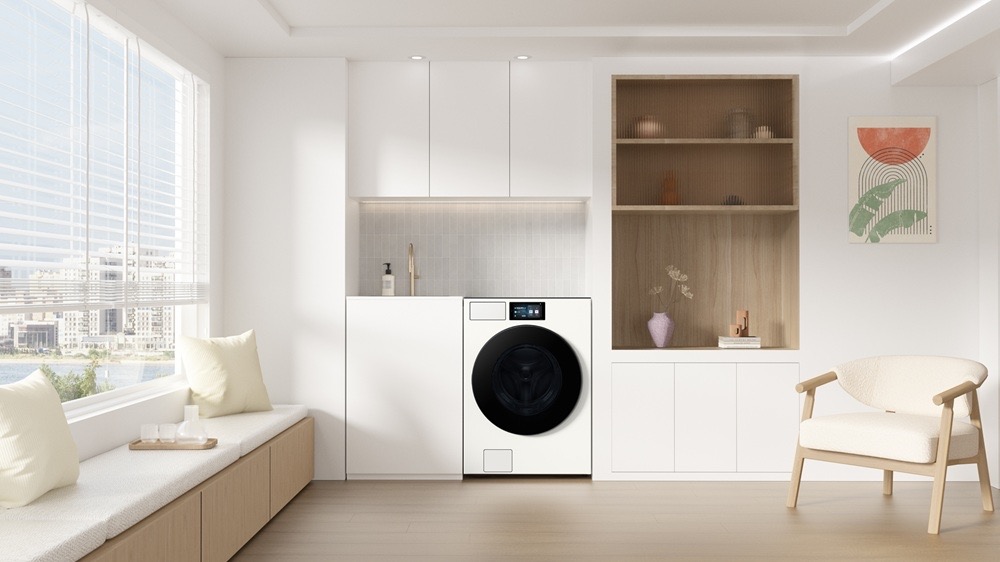
Credit: samsung.com
Samsung Electronics has become the first company in the world to receive third-party verification for carbon reduction effects based on the Decarbonizing the Use-Phase of Connected Devices (DUCD) specification.
The verification, conducted by Carbon Trust Assurance Ltd, confirms the greenhouse gas (GHG) reduction impact of Samsung’s AI Energy Mode in selected washing machines.
It is the first product feature globally to be assessed and validated under the DUCD specification, a new industry standard designed to measure carbon emissions reductions during the actual use phase of connected devices.
Unlike conventional carbon accounting methods that focus primarily on manufacturing emissions, the DUCD framework evaluates emissions generated and reduced while consumers use connected products in real-world conditions.
Samsung said the verification demonstrates that its AI-driven energy management features can deliver measurable carbon savings when activated by users.
DUCD Initiative and Industry Context
The DUCD initiative is led by the Carbon Trust, a global climate consultancy that works with businesses, governments and financial institutions to advance climate action. The initiative aims to establish a standardized approach for assessing, tracking and reducing carbon emissions related to Wi-Fi–connected devices.
Samsung joined the DUCD initiative as a Secretariat member in September 2022, contributing to the development of objective and systematic indicators for evaluating carbon emissions from home appliances.
In November 2024, the DUCD initiative published its first global specification, introducing unified criteria for measuring carbon reduction achieved during the consumer usage phase. This represents a shift from traditional lifecycle assessments that have historically focused on production and supply-chain emissions.
Using the DUCD Part 1: Specification and Guidance, Carbon Trust Assurance Ltd conducted a pilot assessment on Samsung’s global washing machine lineup. The evaluation compared carbon emissions generated between July 2024 and June 2025 when AI Energy Mode was activated versus when it was not used.
According to the verification results, Samsung’s select energy-efficient washing machines recorded total energy consumption of 12.28 gigawatt-hours (GWh) through the SmartThings platform during the assessment period, resulting in 5,266 tonnes of carbon dioxide equivalent (tCO₂e).
The analysis confirmed verified energy savings of 5.02 GWh and GHG emissions reductions of 2,084 tCO₂e attributable specifically to the use of AI Energy Mode.
Samsung noted that this level of energy savings is equivalent to the amount of electricity used by approximately 169,000 households in a single day, based on average daily electricity consumption figures in the United States.
Shahriena Shukri is a journalist covering business and economic news in Malaysia, providing insights on market trends, corporate developments, and financial policies. More about Shahriena Shukri.
.jpg)